

Independent HVAC education for the South SoundPierce · Thurston · Kitsap · Mason Counties, WA
Heat pumps · South Sound homeowner guide

Heat pumps: where they shine and where they need careful planning

A heat pump can heat and cool your home with one system. Modern equipment can perform well in Western Washington, but the right result depends on cold-weather capacity, sizing, airflow, controls and installation quality.

The tradeoffs

Benefits and drawbacks

No equipment type is automatically the best choice. The right question is how well it fits the home, the homeowner’s priorities and the installation.

Benefits

  • Provides both heating and cooling from one system
  • Can deliver high heating efficiency because it moves heat rather than creating it directly
  • Variable-capacity models can provide quiet, steady comfort
  • May reduce fossil-fuel use when replacing or supplementing a gas system
  • Some equipment may qualify for utility or other incentives; eligibility changes, so verify before purchase
Drawbacks / considerations

  • Heating capacity and efficiency vary by model as outdoor temperatures fall
  • Backup heat strategy matters during colder conditions
  • Electrical upgrades may be required
  • Poor ductwork or high static pressure can limit performance
  • Supply air often feels cooler than furnace air, which can take adjustment for some homeowners
How it works

How one heat pump can both heat and cool

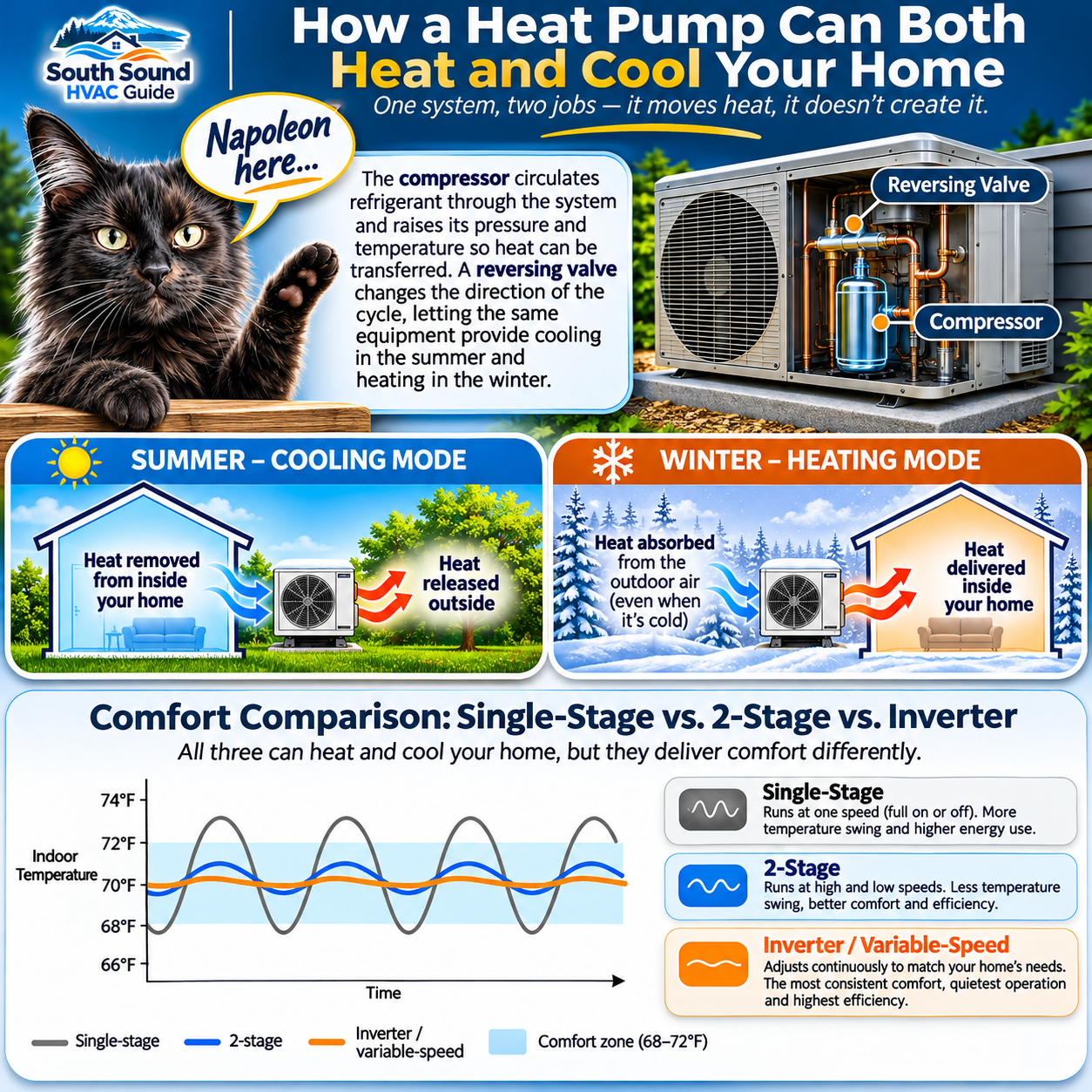
A heat pump uses the same refrigeration system for both jobs. The compressor circulates refrigerant and raises its pressure and temperature so heat can be transferred. A reversing valve changes the direction of the refrigerant cycle, allowing the equipment to move heat out of the home in summer and into the home in winter.

Napoleon the cat explains how a heat pump provides heating and cooling, with a compressor and reversing-valve diagram plus a comfort comparison of single-stage, two-stage and inverter systems.

Cooling mode

The indoor coil absorbs heat from the home and the outdoor coil releases that heat outside. The system is moving heat away from the conditioned space.

Heating mode

The reversing valve changes the refrigerant flow so the outdoor coil absorbs available heat from the outdoor air and the indoor coil releases that heat into the home—even when the weather feels cold.

Important: inverter/variable-speed equipment is not automatically the most efficient or best fit in every application; compare the exact AHRI-rated system, cold-weather capacity and installation design. The comfort curves shown are illustrative. Actual temperature control depends on thermostat settings, equipment sizing, controls, ductwork, airflow, home construction and installation quality.

Efficiency ratings

SEER2 and HSPF2: what the numbers actually tell you

Heat pumps have separate seasonal ratings for cooling and heating. Higher numbers generally mean the equipment uses less electricity to deliver the same amount of seasonal heating or cooling, but ratings do not replace proper sizing, cold-weather capacity or good installation.

SEER2 — cooling efficiency

SEER2 stands for Seasonal Energy Efficiency Ratio 2. It compares the amount of cooling delivered over a cooling season with the electricity used. A higher SEER2 rating generally means lower cooling energy use under the standardized test conditions.

SEER2 rangeHomeowner shorthand
About 14–15Common baseline / entry-level territory
15.2–17Higher-efficiency territory; ENERGY STAR split-system heat pumps begin at 15.2
18+Premium-efficiency territory on many product lines

HSPF2 — heating efficiency

HSPF2 stands for Heating Seasonal Performance Factor 2. It compares seasonal heating delivered with electricity consumed. For South Sound homeowners, this number deserves attention because the heat pump may spend much more of the year heating than cooling.

HSPF2 rangeHomeowner shorthand
About 7.5–7.9Standard / qualifying territory for some utility programs
8.0–8.4Strong seasonal heating efficiency; ENERGY STAR cold-climate ducted systems begin at 8.1
8.5+Very high seasonal heating efficiency on many current systems
These ranges are educational shorthand, not official equipment tiers. ENERGY STAR’s current split-system heat-pump criteria are at least 15.2 SEER2 and 7.8 HSPF2; its cold-climate criteria are at least 15.2 SEER2 and 8.1 HSPF2 for ducted split systems. Tacoma Power currently requires qualifying high-efficiency heat pumps to meet at least 14.3 SEER2 and 7.5 HSPF2, along with its other program requirements. Utility rebate rules can change, so always verify the current program before buying.
Why the AHRI match matters: the rating belongs to the certified indoor/outdoor equipment combination—not just the outdoor unit. Ask for the AHRI Certified Reference Number for the exact system in your proposal, especially when a contractor is claiming a specific efficiency rating or rebate.
Proposal checklist

What to compare before you sign

A proposal should make the important differences visible. If an item is not written down, ask the contractor to clarify it.

Cold-weather capacity

Ask for the exact model and its heating capacity at relevant winter temperatures—not just nominal tonnage.

Sizing

A Manual J load calculation should establish the home’s heating and cooling needs before equipment is selected.

Airflow & ducts

Confirm whether the existing duct system can move the airflow the heat pump requires and whether static pressure will be measured.

Backup heat

If electric resistance or a furnace is used as backup, ask when it operates and how controls are configured.

Installation

Ask about nitrogen while brazing, evacuation, refrigerant charge verification and final commissioning.

Warranty & incentives

Separate manufacturer parts coverage from contractor labor coverage and verify incentive eligibility in writing.

Questions to ask

Use the estimate as the start of the conversation

✓ What is this exact model’s heating capacity at 47°F, 17°F and lower temperatures?
✓ Was a Manual J performed and how does the selected equipment match that load?
✓ What is the backup-heat strategy and when will it operate?
✓ Were the ducts and return-air system evaluated?
✓ Will static pressure and final airflow be measured?
✓ Are electrical upgrades, permits and startup/commissioning included?

Keep learning

Variable-speed vs. single-stage →What makes a quality installation? →